

Uncategorized
- 1099
- 401K
- accounting
- Advanced Child Tax Credits
- Backups
- bank
- banking
- Blog
- breach
- Budget
- business
- cash
- Child Tax Credits
- Church
- church tax
- Contributions
- cost savings
- credit
- credit report
- crypto currency
- data
- deductions
- donations
- economy
- embezzlement
- Employee
- Employee forms
- Employer forms
- Employers
- ERISA
- expenses
- Featured
- financial
- financial statements
- flow
- Forms
- fraud
- Giving
- Health
- Health Coverage
- Health Insurance
- home
- housing
- HRA
- HSA
- I-9
- ICHRA
- Images
- Individual Coverage
- Insurance
- invest
- investment
- IRA
- leases
- legal
- loan
- long-term
- maintenance
- mileage
- News
- non cash contributions
- pandemic
- parking
- Planning
- Podcast
- protection
- Retire
- Retirement
- savings
- scam
- scams
- statement
- Stimulus
- Stimulus checks
- stocks
- tax
- Tax credits
- tax documents
- Tax forms
- tax scam
- Technology
- theft
- Top Stories
- trends
- Uncategorized
- Updates
- virtual currency
- w-2
- World

2023 HSA and HDHP
2023 HSA and HDHP
Contributions and Out-of-Pocket limits
Health savings account (HSA) contribution limits for calendar year 2023 are increasing in response to the recent rise in inflation.
The contributions can come from the employer, employee deductions via payroll or a combination (i.e.: the employer can match the amount that the employee has withheld). matching to support employees’ ability to handle increased health care costs.
| Contribution and Out-of-Pocket Limits for Health Savings Accounts and High-Deductible Health Plans | |||
| 2023 | 2022 | Change | |
| HSA contribution limit (employer + employee) | Self-only: $3,850 Family: $7,750 |
Self-only: $3,650 Family: $7,300 |
Self-only: +$200 Family: +$450 |
| HSA catch-up contributions (age 55 or older) | $1,000 | $1,000 | No change (set by statute) |
| HDHP minimum deductibles | Self-only: $1,500 Family: $3,000 |
Self-only: $1,400 Family: $2,800 |
Self-only: +$100 Family: +$200 |
| HDHP maximum out-of-pocket amounts (deductibles, co-payments and other amounts, but not premiums) | Self-only: $7,500 Family: $15,000 |
Self-only: $7,050 Family: $14,100 |
Self-only: +$450 Family: +$900 |
HSA Contribution Details
*HSA contributions are adjusted for inflation annually against the Consumer Price Index. Catch-up contribution limits are fixed by statute.
* Married couples with HSA-eligible family coverage will share one family HSA contribution limit of $7,750 in 2023. If both spouses have eligible self-only coverage, each spouse may contribute up to $3,850 in separate accounts.
* If both spouses with family coverage are age 55 or older, they must have two HSA accounts in separate names if they each want to contribute an additional $1,000 catch-up contribution.
* If only one spouse is 55 or older but the younger spouse contributes the full family contribution limit to the HSA in his or her name, the older spouse must open a separate account to make the additional $1,000 catch-up contribution.
* Account holders who exceed the contribution limit are subject to an annual 6 percent excise penalty tax on the excess amount unless it is withdrawn from the HSA before the tax deadline for that year.
Annual out-of-pocket limits for ACA-compliant plans (HHS) v/s HSA-qualified HDHP plans (IRS)
| 2023 | 2022 | |
| Maximum out-of-pocket for ACA-compliant plans (HHS) | Self-only: $9,100
Family: $18,200 |
Self-only: $8,750
Family: $17,400 |
| Maximum out-of-pocket for HSA-qualified HDHPs (IRS) | Self-only: $7,500Family: $15,000 | Self-only: $7,050Family: $14,100 |
- ACA-compliant plans (HHS) – Out-of-pocket limits established by the Department of Health and Human Services (HHS).
- The HHS’s annual out-of-pocket limits are higher than those set by the IRS. To qualify as an HSA-compatible HDHP, a plan can’t exceed the IRS’s lower out-of-pocket maximums.

How to manage digital money transfers safely
The ability to utilize electronic payment networks to send or accept cash is becoming more prevalent and easier than ever. However, so does the risk of fraud and scams because cybercriminals know that funds moved electronically are hard to trace and/or recover since there is not a physical check to represent the transaction.
When transferring money online it’s not always possible to know exactly who is on the receiving end of the funds which allows cybercriminals to defraud the payer through fraudulent or unauthorized transactions and data theft.
Recently there has been an increase in cybercriminals scamming people into online wire transfers and payments using the Zelle payment network by tricking users into sharing sensitive information.
Despite legitimate banks and online merchants facilitating Zelle (and other payment options) fraud can still occur as cybercriminals exploit opportunities in the transfer process. For example, Zelle only requires the email address or mobile phone number associated with a Zelle account in order to move funds. This convenience comes with increased risk as Zelle doesn’t have the same protections against fraudulent charges as credit cards or debit cards and the only way to cancel a Zelle payment is if the recipient hasn’t yet enrolled in Zelle. If the recipient is already a Zelle user, the payment cannot be canceled.
Suggested safeguards:
- Don’t disclose personal information without verifying the legitimacy of the source of the request. If needed, reach out to the company directly
- Don’t make your account access easy to guess or discern with limited knowledge of your personal information (ie: pet name, common phrases, etc.)
- Utilize 2-factor authentication for added protection
Never use Zelle when:
- Someone claims to be from a government agency
- You do not know the person making the request (ie: telemarketer)
- Someone claims your account is compromised
- Anyone asks you to send money to yourself
- A friend, relative or coworker has reached out online (without verifying via a phone call that they actually sent the request)

Do You Need To Amend Your 2020 Return?
Congress amended the tax code in March to exempt $10,200 ($20,400 for a couple) of unemployment from taxable income (only for those with adjusted gross income less than $150,000 before the unemployment income). By the time the IRS implemented the change, which was retroactive for 2020, many had already filed their tax return.
The IRS has since come out and said not to worry, they will review previously filed returns and issue refunds beginning in May if taxes were paid on unemployment benefits (up to the $10,200/20,400 limits). However, it may still be beneficial to file an amended return.
While the IRS will refund federal taxes that were paid on the unemployment, it will not recalculate any changes for tax deductions or credits that you might now qualify for after your adjusted gross income is reduced. (It will recalculate credits if they were on your original return, but if you didn’t qualify on the original return, but now you do, you need to file an amended return.) The credits include the Earned Income Credit, college credits, etc.
You may also need to file an amended return to receive a refund from your state. You need to first check to see if your state is offering the same exemption (13 states have not done so).
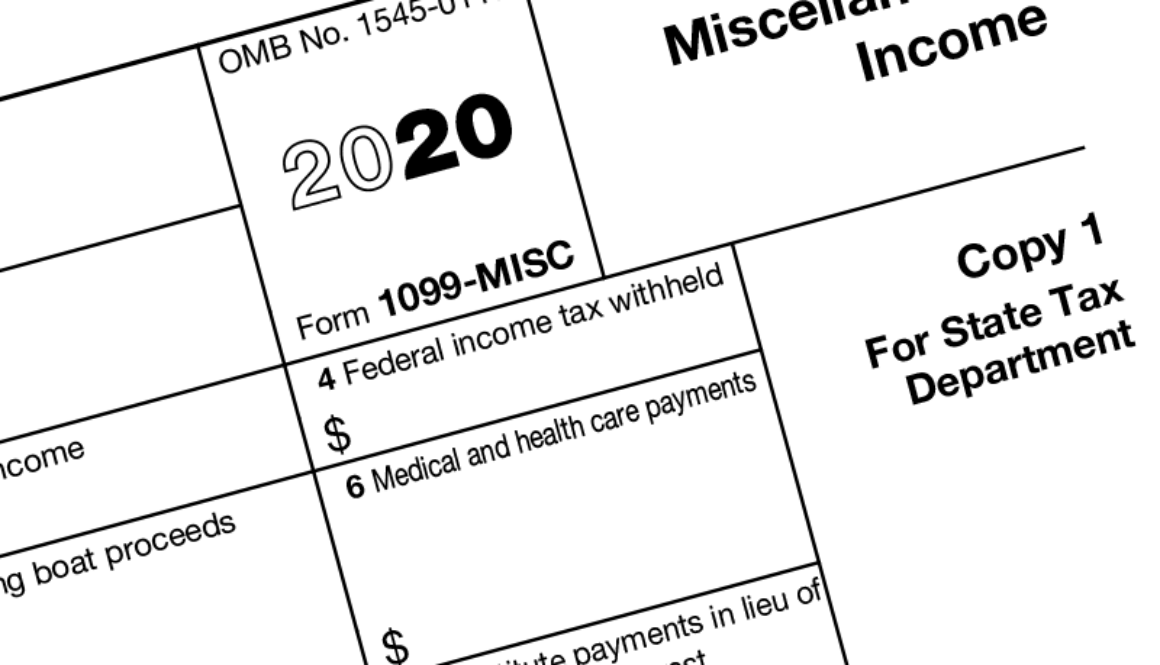
Form 1099-NEC or Form 1099-MISC?
Historically, when you have paid $600 or more during a year to a nonemployee, you were required to file form 1099-MISC (using box 7) by January 31 of the following year. This would include anyone who performed a service (non-employee compensation) for the business or church (independent contractors, guest speakers, etc.).
Beginning in 2020, the IRS has replaced form 1099-MISC with form 1099-NEC for any “nonemployee compensation”. Form 1099-MISC will still be used for other forms of payments. Also, form 1099-MISC box 7 will instead be used for “Payer made direct sales of $5,000 or more of consumer products to a buyer (recipient) for resale”.
Form 1099-NEC is not new, but it has not been used since 1982. “NEC” stands for “non-employee compensation”. What gets reported on form 1099-NEC? “fees, commissions, prizes, awards and other forms of compensation paid to an independent contractor”.
In summary: Form 1099-NEC, Box 1 will replace any payments you previously filed on Form 1099-MISC, box 7.
The deadline for filing Form 1099-NEC is January 31. The deadline for form 1099-MISC is March 31.
As always, you are required to obtain a signed form W-9 from any independent contractor prior to payment.

Changes to Church Financial Statements
If your church is required to have outside prepared financial statements (ie: for a grant or a lending institution), you need to be aware of changes to the statements for fiscal years beginning after December 15, 2017. The results of these changes may result in additional time and cost needed this year for the completion of the church financials.
In summary, net assets are now required to be classified as either 1. Net assets without donor restrictions or 2. Net assets with donor restrictions. Also, earnings from investments must be reported net of related expenses. Finally, expenses must be presented by their natural classification (ie: supplies, wages, etc.) and functional classification (program, general support and fundraising).
The purpose of these changes is to help nonprofits provide more relevant and transparent information about their resources to creditors and other users of financial statements.
There are also new disclosures required that provide additional information on liquidity, availability of resources, board designations of funds and the method of allocation of expenses by function.
Check your loan documents to see if they require annual financials prepared on a GAAP basis (generally accepted accounting principles). If they do, these new rules will apply to your 2018 financial statements.
See Accounting Standards Update (ASU) 2016-14 for more information.

Tax Law Changes
The Tax Cuts and Jobs Act of 2017 includes many changes, including reducing the tax rates of seven different tax brackets. Here are some other changes that may impact you:
- The standard deduction increases to $12,000 for an individual and $24,000 for a family. This change is expected to decrease the number of people who itemize deductions from 30% to as few as 5%.
- Miscellaneous expenses are no longer deductible (ie: tax preparer fees and un-reimbursed business expenses)
- There is no longer a deduction per dependent.
- The child tax credit increases to $2,000 per child under 17. Up to $1,400 per child is refundable. You may also qualify for a new $500 credit for non-child dependents (called a Family Tax Credit). However, there are many restrictions, including that the dependent cannot earn more than $4,150 in 2018.
- In 2018 you can deduct medical expenses that exceed 7.5% of your AGI (in 2019, it increases to 10%).
- Moving expenses are no longer deductible (and they can no longer be reimbursed tax free).
- The AMT limits have been significantly increased to limit the number of taxpayers subjected to it.
- The estate and gift tax exemptions are doubled ($11.2 million in 2018).
Most of these changes expire in 2025, unless Congress extends them or makes them permanent.

2019 Mileage Rates and Tax Law Changes
The IRS has released the new mileage reimbursement rates for 2019. For business related travel, the new rate is $0.58 per mile (up from $0.545 last year). Driving for medical may be deducted at $0.20/mile and mileage for service to a charitable organization is unchanged at $0.14/mile. Mileage for moving expenses is no longer deductible.
Remember – under the new tax law, miscellaneous deductions (which includes unreimbursed employee expenses and home office deductions) are no longer deductible. This lost deduction begins for the 2018 tax year. Therefore, we recommend that employees get reimbursed for business mileage and business expenses. If, however, you file a schedule C, you can still deduct the mileage and home office deductions. This applies to self-employed individuals.
The 2019 HSA contribution limits increased to $3,500 for an individual and $7,000 for a family. If you are 55 or older, you can contribute an additional $1,000.
Finally, if the government shutdown continues, the IRS will be issuing refunds (previous reports said that they would delay sending refunds). To avoid penalties, you should also still file your return and pay any taxes due by the April 15th deadline.

Retirement Contributions
The IRS has issued new 401(k) and 403(b) contribution limits for 2019. The new limit for 2019 is $19,000 (an increase of $500). For those over 50, an additional $6,000 can be contributed, for a total of $25,000. The combined annual limit for employee and employer contributions is $56,000.
The limit for traditional and Roth IRA contributions increases to $6,000 (an increase of $500 and the first increase since 2013). For those that are over the age of 50, an additional $1,000 can be contributed (for a total of $7,000).
If you participate in a retirement plan at work, the IRA deduction is phased out as your income increases. The phaseout for single taxpayers is $64,000 to $74,000 and for married taxpayers is $103,000 to $123,000. Employees must combine contributions made to their 403(b) accounts with contributions made to all other plans in which they participate: 401(k)s other qualified plans, and SIMPLE IRAs. The employee’s total elective deferrals to all of these plans combined cannot exceed the annual deferral limit ($19,000 in 2019 and $18,500 in 2018).
According to the IRS, the income phase-out for taxpayers making contributions to a Roth IRA is $122,000 to $137,000 for singles and heads of household. For married couples filing jointly, the income phase-out range is $193,000 to $203,000.
For more information, visit irs.gov

Year-End Contribution Reports
This is a good time to review the rules for issuing year-end charitable contribution statements.
Charitable contributions must be reported and claimed in the year in which they are delivered to the charity. If you receive cash or a check after December 31st, it should not be included on the donor’s 2018 contribution statement. This is true even if the check is dated in December, but delivered in January.
For the purpose of determining the delivery date, a contribution that is mailed (postmarked) by December 31st, 2018 is considered delivered by that date and can be included on the donor’s 2018 contribution statement. However, if you receive a check in 2018 that is dated in January 2019, it must be held until 2019 and recorded as a 2019 contribution.
Not following these rules can jeopardize the tax exempt status of the church.
Each contribution statement should include the following statement: “No goods or services were provided in exchange for these contribution, except for intangible religious benefits.”
We suggest that you advise your donors to not file their 2018 income tax return until they have received a written acknowledgment of their contributions from the church. Under IRS rules, they may lose the deduction if they file their tax return before receiving the written acknowledgment from the church.